

Plant care
When your plant arrives
Your plant was folded, and sometimes taken apart, so that it could travel safely in its box. Here is how to bring back its fullness: take your time, especially with a large tree.
What is normal on arrival
Branches pressed against the trunk, leaves bent over or slightly creased: this is the plant as it travelled. Creased leaves recover on their own over the next few days.
1. Unpack
Lay the box flat on the floor, open it along its full length and lift the plant out by its pot or trunk, never by the foliage. Remove the plastic film: that is all there is to take off. Your plant comes in its black grow pot, weighted so that it stands steady. If you chose a planter, set the plant in its grow pot inside it (in the 30 cm planter, into the hollow of the black foam), then pour the cork bark over the top: the illusion of real soil is complete.
2. If it is a tree, assemble it
Our trees (olive, fig, eucalyptus, magnolia, plumeria, ailanthus, vine) travel in several pieces, from two to five: usually a trunk and branches. Each branch carries a small number, which you will find on the trunk where it belongs. Push each branch all the way in at its matching number.

3. Shape it
Set the plant in its place, then shape it right there, where it will be seen. Except on orchids and hydrangeas, its branches and stems are wired so that they can be shaped: open them gently, one by one, starting from the bottom and working from the centre outwards, then spread out the leaves. Bend in soft curves rather than sharp angles, and step back from time to time: a silhouette is judged from a few steps away.
Plant by plant
Trees: the branches first, then the small stems, then the leaves. Vary the angles: a tree is never symmetrical.
Palms and large leaves (palm, caryota, cycas, strelitzia, dracaena, yucca): draw the fronds and leaves away from the centre and let them fall in an arc. The stems are wired, but not the small leaflets of the fronds: simply separate those with your fingertips.
Sansevieria and agave: their leaves are wired too. Straighten any that the journey has bent over, then turn the pot to show their best profile.
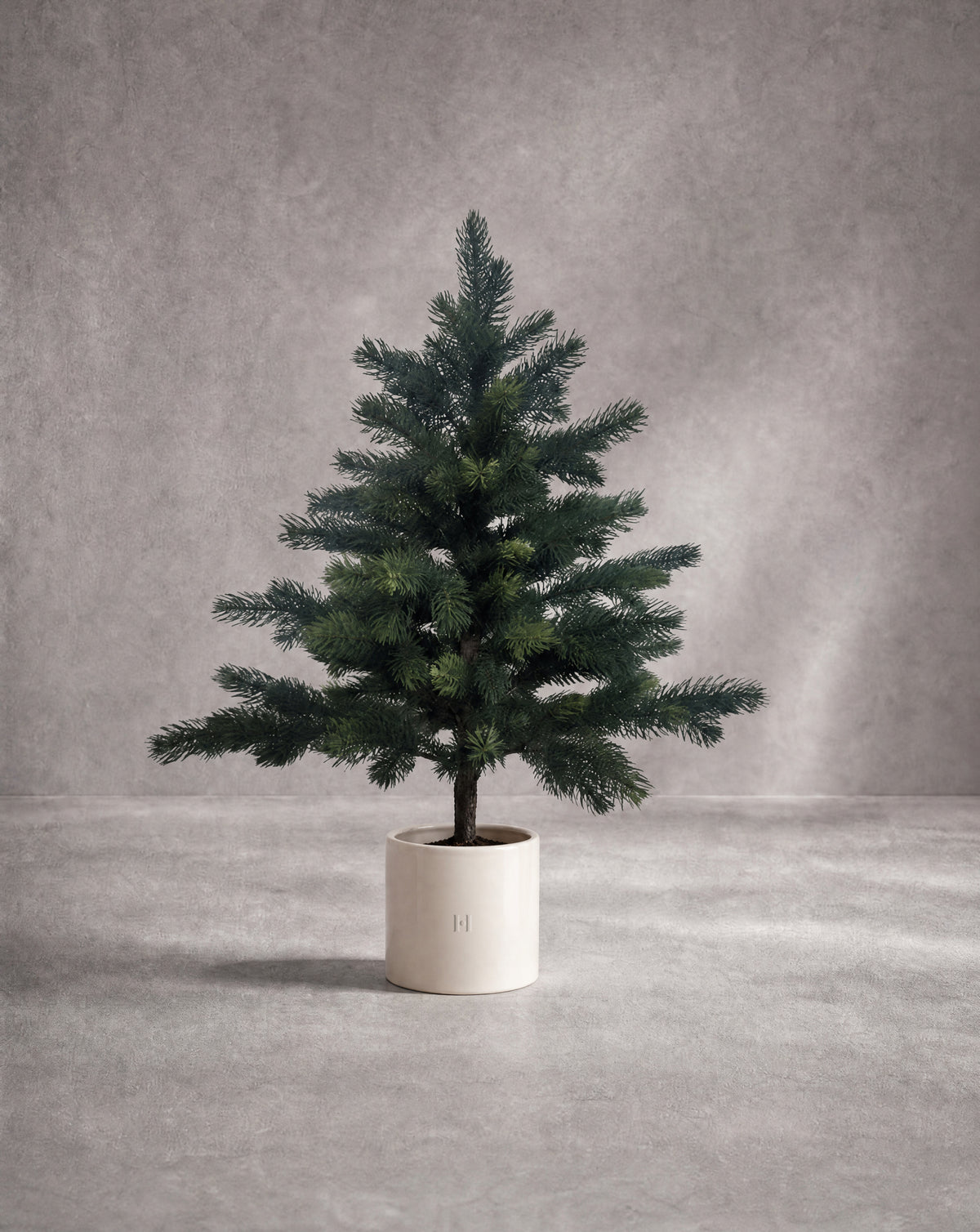
Christmas tree: it arrives already full, but its branches have travelled folded up. Lower them tier by tier, starting from the bottom, then fan each one out. The branches are wired, the needles are not.
Orchids and hydrangeas: no metal wire here. Keep the orchid's stake: just as on a real orchid, it supports the flower stems. Simply give the flowers back their volume with your fingertips.
A problem?
Has a branch come out of its socket? Put a drop of strong glue at the bottom of the socket, then push the branch back in, turning it until it stops: it will hold for good. For any other question, write to us with a photo at contact@hopercollection.com.
Over the years
Our artificial HOPER plants are designed to last for years while retaining their vibrancy.
Daily care
Simple, regular dusting with a soft duster or dry cloth is enough to preserve their shine.
Exposure
Avoid placing your plants directly behind a bay window exposed to direct sunlight. Although our foliage is UV-treated, prolonged and intense exposure can eventually alter the depth of the colours.
Also keep the piece away from direct heat sources. No watering is necessary.